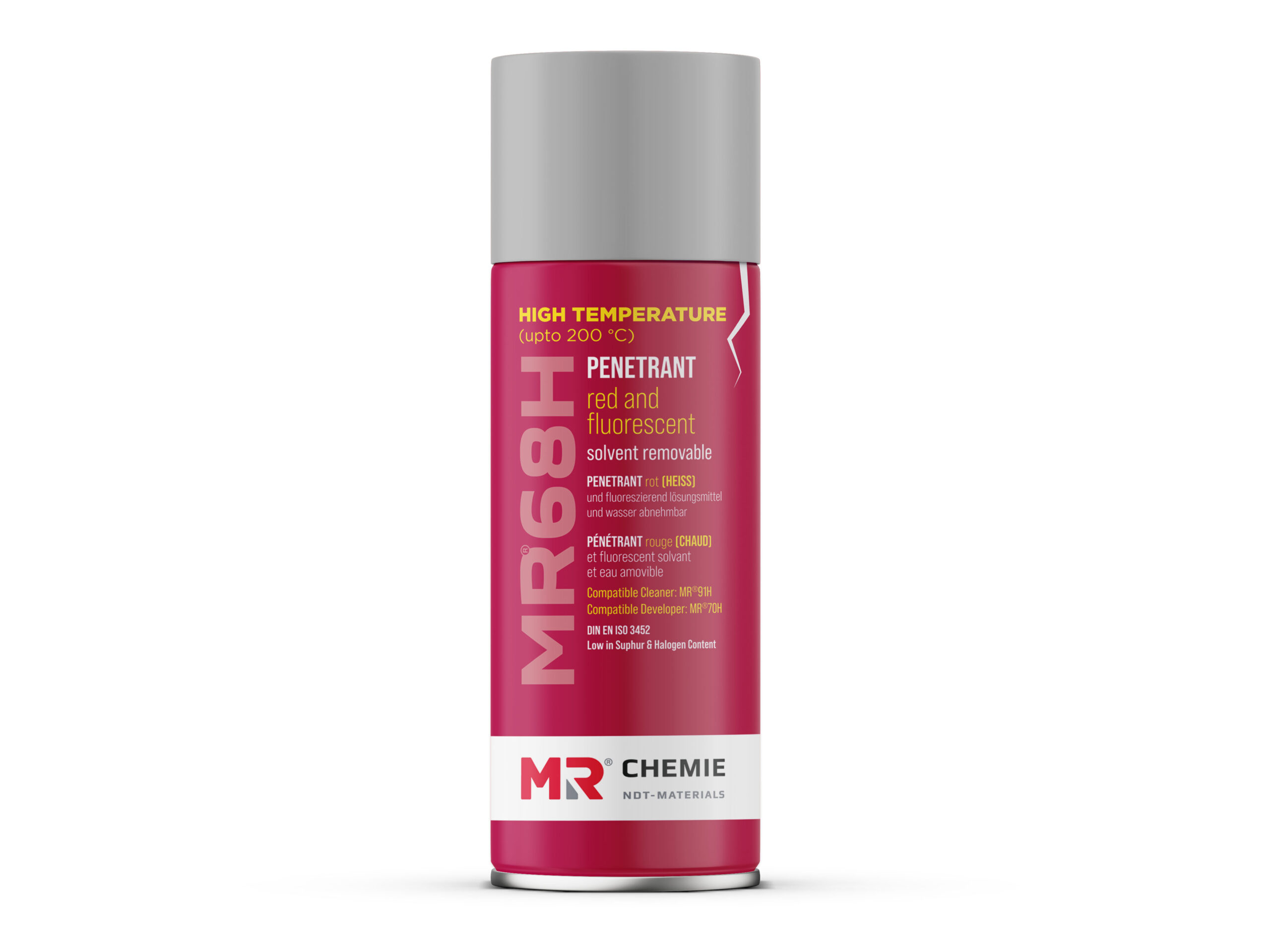
MR Chemie MR 68H Pennetrant Red and Fluorescent (HOT)

SKU :

Pack Size : 400 ml

10 Piece per Cartoon

Downloads

Share Product :

Description

MR®68H is a high temperature solvent & water removable, red & fluorescent colour penetrant for use in Dye-Penetrant Testing for temperatures upto 200 °C . It exhibits outstanding penetrating characteristics which provide maximum reliability in locating surface open flaws and discontinuities. Typical application include casting, forgings, leak testing, welds and general metal work.

Application

⚙️ Multi-Pass Weld Inspection (Interpass Testing)
  • Pre-heating Maintenance: Testing thick-walled joints and heavy structural steel where parts must maintain a constant, pre-heated temperature between weld passes.
  • Root-Pass Testing: Inspecting the critical first weld bead (root pass) for micro-cracks or lack of fusion while the steel is still actively hot.
  • In-Process Defect Gouging: Verifying that a cracked weld layer has been completely ground or carbon-arc gouged out before laying down filler metal.
🛢️ In-Service Petrochemical & Refinery Inspection
  • Live Pipeline Testing: Detecting stress corrosion cracking (SCC), thermal fatigue, and hydrogen blistering on uninsulated, active hydrocarbon and gas process lines.
  • Pressure Vessel Maintenance: Testing the structural integrity of hot distillation columns, heat exchangers, and reactor shells during minor operational slow-downs rather than total plant shutdowns.
🔌 Power Plant Component Evaluation
  • High-Pressure Steam Lines: Inspecting active superheater tubes, steam headers, and main steam lines for creep cracking and thermal stress fractures.
  • Boiler Component Checks: Checking boiler headers and high-temperature manifolds during brief maintenance windows while the system remains bottled up and warm.
🔨 Heavy Forging & Foundry Operations
  • Hot Billet & Casting Inspection: Scanning heavy forged shafts, blocks, and steel castings for cooling tears, laps, and seams immediately after exiting heat-treatment ovens.
  • Die & Mold Maintenance: Testing hot extrusion dies and forging press molds for thermal checking (crazing) while they are still mounted in the machinery.
✈️ Turbine & Engine Component Diagnostics
  • Gas Turbine Maintenance: Evaluating hot-section turbine casings, exhaust ducts, and stator frames right after system test cycles or shutdowns.
  • Heavy Marine Engine Repair: Inspecting massive cylinder heads, exhaust manifolds, and turbocharger housings on large container ships during short port turnarounds.

Direction to Use

Step 1: Pre-Cleaning • Action: Spray MR® 91 H Remover directly onto a clean, lint-free cloth. Thoroughly wipe the hot test area to remove oil, slag, rust, and scale. • Warning: Never spray the remover directly onto the hot metal. It will flash off instantly without cleaning out the cracks. Let the ambient heat completely dry the surface. Step 2: Apply the Penetrant • Action: Spray a thin, even film of MR® 68 H Penetrant onto the hot component. • Dwell Time: Allow it to sit for 60 to 120 seconds (1 to 2 minutes). • Warning: Do not leave it on longer than 2 minutes. At high temperatures (closer to 200°C), the penetrant carrier can bake and dry out, which ruins the test. Step 3: Remove Excess Penetrant • Action: First, use a clean, completely dry cloth to wipe away the bulk of the red penetrant. • Action: Second, lightly moisten a fresh cloth with MR® 91 H Remover and wipe the surface until the pink background haze is completely gone. • Warning: Do not spray remover onto the part. Doing so will wash the penetrant out of the actual cracks, leading to a false-safe reading. Step 4: Apply the Developer • Action: Shake the MR® 70 H Developer can vigorously until the mixing ball rattles freely. • Action: From a distance of 20–30 cm, spray a light, uniform layer. The surface should look like it has a very thin, white frost coating. • Development Time: Let it stand for 10 to 60 seconds. Step 5: Inspection & Interpretation Examine the white developer layer immediately using one of two lighting methods: • Daylight / White Light: Cracks and defects appear as vivid, sharp dark pink lines or dots. • UV Light (365 nm): Under a blacklight lamp, the defects fluoresce as a bright, glowing neon orange.